Podcast Summary:
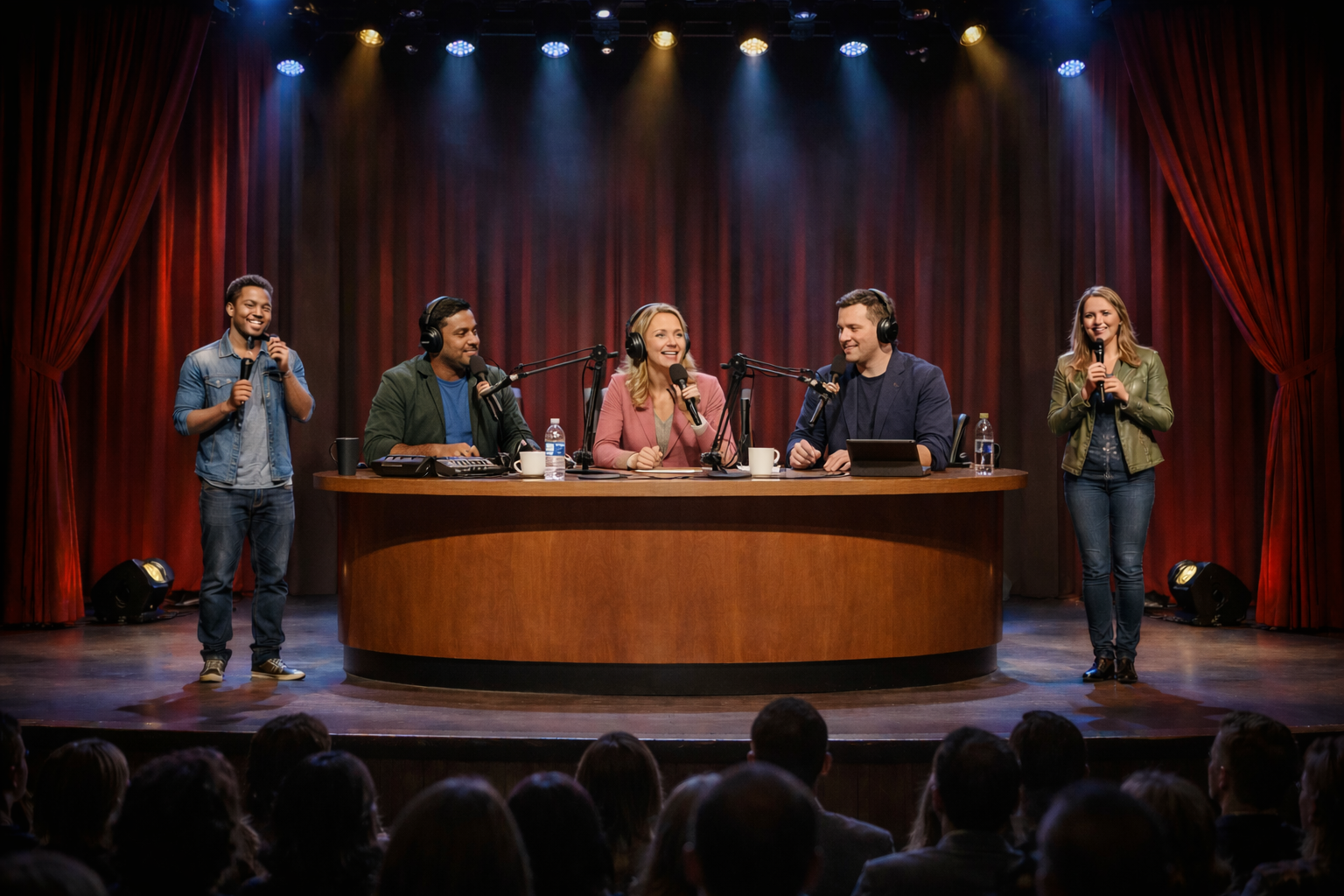
Blind Abilities – The Musical reimagines the podcast as a live theatrical broadcast, blending news-style dialogue, personal storytelling, and original music into a fully immersive audio stage. Framed as a newsroom, the episode moves through three powerful themes: wearable technology, progressive vision loss, and the enduring importance of Braille. Original songs are not interludes but narrative engines, giving emotional shape to independence, fear, preparation, and identity. Conversations flow seamlessly into lyrics, turning lived experience into melody and reflection into rhythm. Voices from the field, candid roundtable moments, and musical storytelling create a sense of movement, as if scenes are shifting behind the curtain. At its core, this episode is about transition—technology becoming invisible, vision loss accelerating, skills becoming survival, and Braille standing firm as literacy and infrastructure. Blind Abilities – The Musical is not just heard; it is felt, inviting listeners to imagine the stage, recognize themselves in the stories, and hear blindness through harmony, honesty, and shared humanity.
For more podcasts with a blindness perspective check us out on the web at www.blindabilities .com. And if you want to leave some feedback give us some suggestions give us a call at 612 367 6093.
We’d love to hear from you. I want to thank you for listening
Full Transcript:
Jeff: Good evening, and welcome to Blind Abilities News.
Cheryl: Where accessibility meets innovation.
Sree: And lived experiences becomes the headline.
Jeff: Tonight. Wearable technology that blends in instead of standing out.
Cheryl: The reality of degenerative vision loss and why it accelerates.
Sree: And Braille called outdated by some. Essential by those who use it.
Jeff: We begin with wearable gear. Laurie and Pete are out in the field where style tech and independence intersect.
Pete: That’s right. Jeff. These aren’t devices you explain anymore.
Lori: They’re devices you wear, and sometimes nobody even notices.
Pete: And that changes how people treat you and how you see yourself.
Song “Wearables”:
{Music}
They don’t hang heavy on my face. Don’t shout instructions. Don’t take up space. No wires, no warnings, no medical stare. Just something I put on like anyone would wear. They used to ask me, what’s that thing you’re using? Now they don’t ask anything. That’s silence. That’s freedom. I don’t have to explain my need. I don’t have to slow my speed when design stops standing out. That’s when independence counts. Just wear them. Let them disappear. Just wear them. Let the moment stay right here. When the tech fades out of you. Life comes rushing back to you. Just wear them.
Jeff: From assistive to invisible.
Lori: Design finally listens. And independence lasts longer.
Song 1: Double the battery means double the trust. Not hoping it lasts. Not wishing it does. I don’t plan my day around fear. I plan my day around living here. When it lasts long enough. I stop checking the clock. I stop calculating exits. I stop bracing for drops. Just wear them. Nothing extra to prove. Just wear them and move like you move when it blends. And it lets me out when no one notices. That’s what it’s about.
Pete: That battery life. That’s the difference between confidence and contingency.
Jeff: And that’s why wearables aren’t gadgets anymore. They’re gear.
Song1: Just wear them.
Jeff: Now Cheryl and Sree, I remember the days where we had tethers and all sorts of stuff. And now you think about it. Wearing glasses, holding a GPS unit and trying to navigate with all these devices strapped to you and stuff. I just wanted to wear stuff that is insignificant or autonomous. You know, you just look normal and stuff. And that’s where I think smart glasses, the meta Ray-Bans come in where you’re just wearing sunglasses, but you have some technology working for you.
Sree: I definitely agree, I think within the last three years, for those who have low vision or who are visually impaired, these smart glasses are a major product that came into our lives, at least for me. I’ve found having my hands free, not having to hold the phone out like I’m one of those who can see kind of walking around and paying no attention to their surroundings. But with these glasses, I’m walking like a normal person, trying to do the normal things.
Cheryl: And I love that mine are purple because they’re fashionable as well.
Sree: One of the important things, you know, with these glasses going back to previous glasses, you know, they don’t look like normal glasses. It made you look odd, made you look different from others. And now with these glasses, you look more like everybody else as you walk around. And I feel that we’ve gotten more independence with these things, especially with these glasses with AI built in.
Jeff: I think what you mentioned about hands free is 90% of what I like about it. And, you know, Ray-Ban. How can you go wrong with trying to fit in with just an average pair of glasses? Fitting in is the key thing here. I don’t want to draw attention to, you know, loud voice over or, you know, people come over and you turn the TV on, like when the grandkids come over and I turn the TV on and they go, what’s that voice explaining the cartoons? So I had shut off audio description. Or when you’re going someplace and you have the cane and other types of devices, you know, there’s certain things that become our scarlet letter. You know, people see they are were identified as blind. But I think with some of these wearable devices nowadays, we’re on the brink of fitting in without drawing so much attention towards our needs.
Cheryl: Well, and also the practicality portion. I mean, you got a cane in one hand, so you’re already out one or a dog handle. And then like if you have anything else in your other hand, you can’t have your phone there. So it’s just practical.
Sree: And also cost if you think about it, you know, these devices previously was in the thousands and now we’re at the hundreds and we’re getting a lot of competition. You know, they always say competition is good. And these wearable devices, you know, as you read, you’ll find out that there are more companies coming out with these. And I’m looking forward to seeing what CES is going to come out with these kind of wearable devices from other manufacturers. And hopefully that will result in better technology, better looking glasses, better accessibility, better AI, you know, all the better things that come with competition. And I did try the Oakley Vanguard and I will say they look pretty nice. You know, I was a little skeptical when it was gold and I did try the gold and my wife said it’s not a good fit and they have other colors. So I think this is slowly evolving to something that some have said could replace the phone, and that potential is there.
Announcer: Pete Laurie, action 120.
Pete: Laurie, the next song coming up. Oh my about going blind I.
Announcer: Action in 120.
Lori: Yes, it was very beautiful.
Pete: I actually shed a tear when I listened to it because it’s so real. It hits home. I think all of us probably feel some of that when we listen to that tune. The melody is gorgeous. And Jeff, you did a fantastic job working on that and the lyrics are just right on. I can’t believe it.
Lori: Yes, it struck home with me as well as a person with RPE. That’s my whole life, you know? That’s my whole journey with This is how that song conveyed it.
Pete: Yeah, yeah. I like when it starts in the corners. The vision doesn’t go away all at once. It just kind of starts creeping into the corners and starts shrinking in towards the middle. And I don’t have R.P., but I have macular degeneration. I started noticing it when I was really young, and over the years it was just a very, very slow burn, you know?
Lori: Yeah, I think we can all relate to that. Yeah. Year by year, day by day.
Pete: (sings) Day by day.
Lori: I’ve noticed just in the last well, since I moved to Minnesota, I barely used a cane in 2004. That was 22 years ago. Now I’m completely dependent on a cane. You know what I mean?
Pete: Absolutely. Yeah.
Lori: Yeah.
Pete: That’s about when I started using the cane, too, back in the early 2000.
Lori: Yeah.
Pete: Yeah.
Announcer: Quiet on the set. Quiet on the set.
Jeff: Vision loss isn’t linear.
Cheryl: It doesn’t fade politely.
Sree: It accelerates.
Pete: At first you compensate. Then one day, you’re negotiating with darkness.
Lori: And the future you thought was distant suddenly feels close.
Song “It Didn’t Rush In”:
{Music}
It didn’t rush in. It took its time.
Quarter by quarter, year by year. First it soften the edges, and it’s short in the day. Until the light I depended on started slipping away.
People say at least you still have some.
They don’t see how fast some disappear. I learned to memorize rooms. I learned to trust in my hands. I learned that preparation One is how you make mistakes. The darkness isn’t empty. It’s not the end of me. It’s filled with skills and voices that help me still be free. The fear isn’t blindness. The fear is waiting too long to prepare for it. So I build while there’s light. I train while I can. I don’t wait for the night to understand. If the dark ever comes. It won’t find me unready. The darkness isn’t empty. It’s steady.
Sree: It doesn’t arrive all at once.
Jeff: It compounds and preparation becomes survival.
Pete: Skills aren’t optional. They’re insurance.
{Music}
News bullentin Sound
Jeff: On blindness, we all have our journeys and my journey is continuing. And slowly but surely, the degenerative eye disease I have is taking its toll, and I’m seeing less and less as I go along. And honestly, I have to consider that for the future as well. So practicing braille learning techniques or upping my game on my accessibility devices a little bit, things I have to consider.
Sree: You know, my story is a little bit different because my older brother and my older sister, they also are blind, and they were blind before me. So I had the opportunity to observe them, learn from them. In the event that, you know, I also end up getting the same disease, which I did. But being around them and learning the process that they went to help me. And one thing I did is I didn’t wait till I was losing my sight to learn. I learned as I observed them, I started learning. So when I was early diagnosed with RP, I started just moving forward and learning what I needed to do about accessibility. And at this point I’ve not learned Braille, but it’s on my plate for hopefully this year I’ll kind of start learning that. But I’m I hate to use the word. I was lucky that I had siblings, but it did help me and I appreciate what they taught me as they went through the journey. And I’m grateful for all the technology that we have now.
Cheryl: Me too. I’m so thankful for all the technology we have because when I fully lost my sight years ago, there wasn’t as much as there is now. So it’s definitely especially as we were talking about the wearables and all of the different things, that was not a thing. So I think now we can be a lot more efficient than we could back in the day. So my journey to vision loss started at birth, and then at 16, I lost all the sight in my right eye due to a surgery. And then I was dependent on my left eye, which always was my worst of the two. And about what has it been now? Like 12 years? I’ve been totally blind. Now I can’t even see the sun. So like, no, no light, no nothing. Although I disagree with the statement about darkness because I don’t actually see darkness. It looks like I’m in a lit room all the time, but obviously I can’t see the light and I’m seeing a colorful kaleidoscope all day. So my favorite color is purple, and I get to see it every once in a while. When it comes into my vision from these little colorful things that happen all day long. So it’s not darkness for everyone. It can be beautiful.
Jeff: I think the acceptance part of it is something you kind of have to swallow a little bit, because until you accept it, it’s hard to build a roadmap like get training or to start using the cane. Acceptance is a personal thing and some people around you, oh, you’re doing great. Oh, you’re doing fine. That’s fine, that’s fine. It may seem all good, but when you live with it 24 over seven, you know whether you’ve lost it all or you’re losing some more. And the road ahead looks colorful as.
Cheryl: Yeah.
Jeff: As you put it, or colorless, I guess. You know, everyone is so uniquely different, and their journeys are so uniquely different that everyone has their own book and maybe similar, but totally unique.
Sree: I also say as you go through this journey, try and enjoy it. It’s not all downers. There’s so much things you’ll achieve and you’ll feel the joy of achieving these things. I know for me, I used to be able to run and now I have to kind of crawl and walk, and that was tough to deal with. But I knew that that’s how my journey was going to be. And, you know, nothing’s going to happen really quick anymore. It’s going to take some process and some time, and I learned to deal with it. And once I learned to deal with it, it made my journey a lot more happier or pleasant for me. Like I said, having my sister and my brother go through this and then saying to myself, they’ve done it, many others have done it. Blind abilities gave me an outlet to understand things and so many other organizations out there. And as you get involved more and more, that journey becomes much more enjoyable.
Cheryl: Yeah, I agree with that. I mean, especially I mean, think about it. We’re all talking to each other. We wouldn’t be if we didn’t experience vision loss. That’s what’s brought us all together. And so there are some good things that come from it as well. Like my best friend, I met her when I was in seventh grade, I believe, and she was in eighth grade, and our TVI brought us together and we’re still friends. We still talk to each other all the time, and so we tend to think of it as like the worst case scenario and mostly a societal thing. I mean, they fear blindness more than they fear cancer, which, you know, like to me is crazy, but it’s such a societal. It’s just the worst thing that ever could happen to somebody. Or at least that’s the belief. And sometimes there are some really great things that come out of it. I mean, blind abilities. What was that like 2011 or something like that? I mean, I still talk to Jeff and so, hey.
Sree: And for me, you know, I’ve met so many more interesting people after I lost my sight than I did when I could actually see. And if you really ask my wife, she’ll probably tell you that I’ve been much more happier after I lost my sight than I was when I could see. Maybe because I find my life more meaningful, or I’m doing things that brings more enjoyable to me. So it’s not all been bad.
Cheryl: Yeah, one thing for me is just the stability. Like when you’re going through vision loss, it’s like you’re at a point and then you get to another point and you get to another point and you keep like recalibrating basically. And when you’re totally blind, like you’re just there, you’re stable, like there’s nothing more to, you You’re not going to wake up one day and be like, oh, I lost my sight. It’s like it’s gone. So now I just have to adapt to what I have.
Jeff: Yeah. Sitting on that fence of low vision and blindness, it’s a tough area. You feel very good when you’re a high partial. But as you move towards the other side of that fence and you finally ease yourself down into that zone, it’s good in a sense, like you said, it’s, uh. What was the word you used?
Cheryl: Stable.
Jeff: Yeah. It’s something you can build upon. Yeah. One thing that I learned was I thought I was in a terrible spot, and then I went to a training center. I took a tour of it, and I met a bunch of other people. And at first I was like, oh, my God, I’m not that blind. I don’t need this. But when I did start there two weeks later, I thought they were the greatest people in the world. So it changed my perspective. They were doing things confidently. They were busy doing things, and I wanted to be busy too. So it’s not like I left the sighted world, abandoned them and went into it. It was like, oh my gosh, the possibilities that are there when you meet other people. You had your brothers and sisters situation, you met someone a TBI connected you up with. And once you start meeting other people in the within, I don’t know if it’s community, but within the blindness world, it’s like really can change your perspective towards the good.
Sree: I completely agree. I always tell people you got to be in the community, then you’ll get a much better comfort zone and you’ll see all the different stages in the group. You know, you’ll see the ones that have just started losing their sight, and those who are going through the journey and those who’ve been on this journey for many, many years. When I go to the library and I teach this voiceover class, I always tell people about my three T’s. It starts off being terrified. You know, that you’ve lost your vision. And then I talk about all the different trials you’ll go through, and every trial that you succeed, you feel the last t, which is triumph. You know, you feel the success of doing something, accomplishing something.
Cheryl: Yeah. I have a student who’s going through vision loss. So he’s new to all this. And he was like, well, I talked to you every day. And he’s like, you’re just so happy and excited. And he’s like, it can’t be that bad. So sometimes, you know, just knowing somebody else can help too.
Sree: Yeah, I completely agree with that too.
{Music} News Alert Sound
Cheryl: Some say Braille is obsolete.
Sree: Usually people who never try to learn.
Pete: Braille doesn’t compete with technology. It stabilizes it.
{Music}
Song3 “Braille”
: They say it’s old school. They say it’s slow. They say the world moved on. But I still know when the battery dies and the screen goes black, Braille doesn’t disappear. It waits right back. It takes some time. It takes some grit, but once it’s there, you don’t forget it. Read it with your hands. Let the dots be clear. Read it with your hands as literacy. Write here. Literacy. Doesn’t expire. It ups. And stays with you. Braille ins’t nestalgia. It’s infrastructure. Read it with your hands and know where you are.
Jeff: I hear talk out there on the internet, on other podcasts and other places, wherever you go. Some people, when they talk about Braille, they talk about how it’s dead, how it’s old school. And yet I honestly think that these very same voices do not pick up Braille. They don’t practice it. I have a I’m reading Johnny Appleseed right now. I’m halfway through it and it’s a kid’s book. It’s easy reading. It’s supposed to be easy reading. But every once in a while you come to a word like Pennsylvania. Yeah, that’s a long word. You know, it’s like you kind of know it’s there, but you want to find every letter, you know, s y, you know, all that stuff. But I noticed that I pick up on the spelling and with voiceover or, you know, using a screen reader, I really don’t pay attention to spelling. I’m listening. I’m just listening. I’m not going through an editing. Sometimes I have to. But when I was in Braille, it was like, oh, that’s how you spell that, you know, Johnny and NY, you know? Huh. So it was really interesting. And then I have a calendar, I have the Snoopy calendar, and I just put up the new one this year. So I use it in certain areas and I have a slate and stylus, a no card, one where I slide a three by five or a four by six.
Jeff: I think it’s three by five into it, and I have a stylus, so I can take down a quick note if I need to. If I’m sitting in a meeting or something, I hear something. I can just click, click, click, click, you know, just punch it in there. I’m not going to write a book. I’m just going to take down a note or it’s in room 307 or something like that. And for all those people who live in apartment 307, I wasn’t referring to you, but but it’s just a way to do it. We all remember the five paragraph paper. Well, I used to write down five words and that would lead me. I could give a speech and have that card right on the podium, and it would give me that key word for the next topic. So there’s ways to use it where, yeah, You’re not reading War and Peace, but you’re at least utilizing it. And once you start practicing it a little bit, like I set it on the dinner table, it’s sitting there right now, and I just flip the book over and start where I left off. And right when I’m having a sandwich or something, I just take an extra ten 20 minutes and start reading a few more pages. Keeps it relevant.
Cheryl: I absolutely love Braille. Like I’ve always been really fast. I actually decided years ago to teach myself Braille, um, because I kind of knew that maybe one day I wouldn’t be able to see. And so I sort of did that in advance. But I just love it. And especially now most of my day, I’m using a screen reader. I’m talking to people like there’s just so much noise. And if I sit down at the end of the day and and read Braille, it’s quiet and it’s therapeutic. So I love that NLS e-reader that they have now.
Jeff: And Sri, I would suggest to you to get an alphabet card. It’s just, uh, I don’t know, three by six card. And it has a through Z and then one through ten and might have a little saying at the bottom. And an example of contraction, maybe, but there are just simple cards. You can get them from the national braille press. Yeah. And you can get these cards and usually they’re free. Or if you go to a convention or something, go find their table and stuff and get one, because I use that. And I decipher to note that these when I first went to training, these girls put a note on my locker and holy cow, I had to decipher it. So I figured out and they were inviting me to a party. I mean, that’s an incentive to learn Braille right there. I didn’t learn much in my class, but when people started writing you letters and they were pissed off because they were, they had the right in grade one, you know, so they wanted to get me up to grade two real quick. So it’s kind of neat. If you ever get a chance to have a pen pal like you want to learn Braille, just put a stamp on a manila envelope and send it to the person. Put a piece of cardboard in there so it doesn’t all get squashed. And, uh, it’s very interesting to have an incentive, like a pen pal, to read a little bit. You know, it’s not going to be long. It’s just enough to get you get a taste of it.
Sree: Well, you know, for me, I’m definitely in the other extreme. Uh, you know, when I was losing my sight, I always told myself, you know, with the current technology, I won’t need to learn braille. And as I gone through this journey, I find telling myself, boy, if I just knew Braille, it would have probably made this situation much easier. Because sometimes I’m using my finger to trace something to figure out what it is, what it actually is, especially like on elevators or in my recent flight when I went to India. You know, the seats also had Braille, but I had I couldn’t read it. So I was, you know, trying to count seats to get back from the restroom, back to my seat. And I always, like, mess up. So there are definitely Reasons for me to learn Braille. And, you know, I appreciate both of you guys talking about it, because that gives me more incentive to start the process. And that is going to be one of my things to do this year is to learn Braille.
Cheryl: So yeah, and Hadley has a really great program. They’ll send the stuff right to your house.
Sree: Cheryl, it’s funny you mentioned that because that booklet is right here at my desk. It, It’s literally I’m not lying to you. It’s sitting right next to my desk. So it is, you know, like I did get this from them. Uh, and believe it or not, I got it back probably a couple of years ago. Uh, but I’ve been always putting it off. But it is I, I brought it this year, put it next to my desk. So it is definitely something that I’m going to try and do because I definitely.
Jeff: Hadley is saying it’s on you.
Sree: Yeah, it’s all me now. It’s like, I have no excuses. I made so many different excuses, you know, with everything that that I don’t need it. Especially I find like Cheryl, you made a good point is sometimes, you know, I’m trying to say something and there’s just so much noise and I don’t know what I need to say because I really can’t hear it. But if I had it in Braille, I could probably be successful in it.
Jeff: And people talk about that. It’s extortionate to get these refreshable Braille units and stuff like that. But if you order a children’s book or something of that nature, you can get that quiet, that silence and just enjoy the book, especially if you know the book, Charlotte’s Web, or you know, anything else, Old Yeller. Now that’s a bigger book. But the short books, Doctor Seuss, well, he kind of rhymes some weird words. So I would stay away from that for first. But just simple little books or something that you’ve read before. It’s a good way to do it because you can anticipate what’s coming up.
Sree: Yeah, even just a very basic example is what we’re trying to do today. Now, I use my phone or my computer to read what I want to say, you know, in one year, listening to what it’s trying to do. And then I’m trying to also go along with everything else is going on. If I did know Braille, it braille, it would have made this process probably a lot easier for myself.
Jeff: Oh, and Cheryl will probably be able to speak to that. You can read Braille and talk at the same time.
Cheryl: Yes, and I’ve done like a lot of my presentations. I had to do like the VA, I had to do presentations. So I would just write down in Braille kind of what I wanted, like just the topic, not word for word, but, you know, just the topic. So it kind of kept me on pace as well.
Jeff: Yeah, that’s what I do with the notecards.
Cheryl: But even if you know grade one, you can read door and elevator information and that kind of thing because that stuff normally isn’t grade one, right?
Jeff: Yeah. Like the tables at McDonald’s have a little circle there and it’s in Braille.
Cheryl: Yeah, yeah, I’ve read those. Braille is always cool when it’s unexpected. They have these things that they just put in the park here at my house, like near my house, and they’re like little signs and they have braille on them for kids. I’m like, that is so cool.
Sree: I will tell you, my daughter got a tattoo in Braille.
Cheryl: Oh, cool.
Sree: And she told me, you know, dad, I got this for you. And it says perseverance. And that’s kind of made me really think about it. You know, it is you know, it’s a journey. But, you know, you got you got to persevere to go through this. And she always reminds me about it. So, you know, I appreciate her getting that one.
Jeff: It is a neat journey. I mean, it’s the only journey I know. It’s the only chapter that’s ahead of me. So it’s I like it, I like life, and, uh, this is the way I live it.
Cheryl: And as we all age, like Braille would be good for hearing loss, you know? So if we can’t hear the screen reader anymore, like, at least we’d have something.
Jeff: Braille Louder!
Cheryl: Yeah, All caps!
Jeff: Bring out the Perkins.
Cheryl: I actually have one on my desk as we sit here.
Jeff: I was just going to turn around and hit a couple keys. I got one sitting on the shelf right over here.
Cheryl: I love it, though.
Sree: Educate me. For someone who is not a Braille user. Has the Braille technology, has that evolved or is it still the same, or has this gotten easier? Better? Cheaper? What is it for someone who is interested in looking at Braille but doesn’t really know yet?
Cheryl: I think it’s improving and it’s changing every day. There’s the Mac just included in voiceover has like a Braille system. Now that they just put in like iOS 26 and the Refreshable Braille. Now you can get from NLS. They have an e-reader. And then also they have what they call multiline braille now. So you can actually use like a refreshable braille display to see images like it comes up in braille. So you can feel it rather than just the words. Yeah. It’s evolving like every day.
Sree: So I was at the ACB National Conference, and I looked at one of the products, which looks like an iPad, but it had pixels that raise up and down. So when I look at a file, an image, I can feel all the texture of the image. I thought it was really cool, but I also realized it was very, very expensive. You know, just.
Cheryl: Oh yeah, you’re probably talking about the monarch.
Jeff: Mhm.
Sree: Obviously, you know, it reminds me of the glasses that most people couldn’t afford. The price was just way, way out there. Has that kind of technology. I know this is kind of maybe this is new, I’m not sure, but has Braille technology itself, prices have gone down or is it always been around the same price?
Jeff: I think the mantis is a breakthrough in a sense, where people don’t actually need an entire computer, where they take some notes and stuff like that, but basically they use it as a refreshable Braille or a chameleon, 20 cells compared to 40 cells, and that’s about 2500 or 17 to 1800, something of that nature. Is that right, Cheryl?
Cheryl: I think that’s yeah, I’ve been looking at these different ones. I’m kind of torn between two and I can’t make a decision. But yeah.
Sree: And are there organizations that will support in getting you these devices, or is it kind of like like the wearables like before, you know, you know, you it basically comes out of your pocket.
Jeff: It depends on if you’re young and going to vocational rehab and find that it would be beneficial to you, or if you’d have to find some support that way or out of pocket. You know, I consider it if you’re going to spend $2,700 on one, you should be using Braille.
Cheryl: Mhm.
Jeff: Don’t go get one to learn Braille. Like she said the NLS they have the like. Cheryl tell them about the NLS and how he can get that.
Cheryl: So it’s called the NLS e-reader. And they have two different versions ones made by Humanware which is pretty common in braille display field. And then there’s also one by zoom. And that depends on which state you’re in. So I have the Humanware one. But you can actually connect this thing to your computer. You can connect it to your phone. So you can use it as a Braille display. It’s not just for Braille books.
Sree: So going back to basics here, what is a Braille display. Because my vision of display is the same as the braille display. Or do I have my terminology mixed up here?
Jeff: Picture a row on your keyboard as you draw your fingers straight across it left to right. That would be cells, whether it be 20 cells or 40 cells, and each cell is like a six on a die, which is a Braille cell. And so some dots pop up to form letters or contractions and stuff, and you read it from left to right, and then you line feed. And so you’re continuously moving that line up. If you’re reading a book or reading notes, whatever you’re doing. Basically, refreshable Braille is something that takes information from somewhere, whether it be the phone, a drive, or your computer, and you’re reading it in Braille, what’s maybe on the screen or what’s on the in the book. So that’s a refreshable where a note taker is something that tries to be a computer and all in one they get very expensive. But the thing that has changed today is, like Cheryl mentioned, Apple bringing on Braille into their device and stuff, where a refreshable braille device is pretty much all you would need if you’re going to tandem it up with another device.
Sree: Okay. Thank you.
Jeff: Is that right, Cheryl?
Cheryl: Yep.
Jeff: This has been blind abilities News.
Cheryl: Where the headlines are live.
Sree: And the independence is built.
Lori: Thanks for listening.
{Music}
Jeff: I’d like to thank everyone who participated in the creation of this blind abilities. The musical. Big shout out goes out to Cheryl, Laurie, Pete and Sree.
{Music}
Jeff: For more podcasts with a blindness perspective check us out on the web at www.blindabilities .com. And if you want to leave some feedback give us some suggestions give us a call at 612 367 6093.
We’d love to hear from you. I want to thank you for listening and until next time bye-bye.
[Music] [Transition noise] –
When we share-
What we see
-Through each other’s eyes…
[Multiple voices overlapping, in unison, to form a single sentence]
…We can then begin to bridge the gap between the limited expectations, and the realities of Blind Abilities.