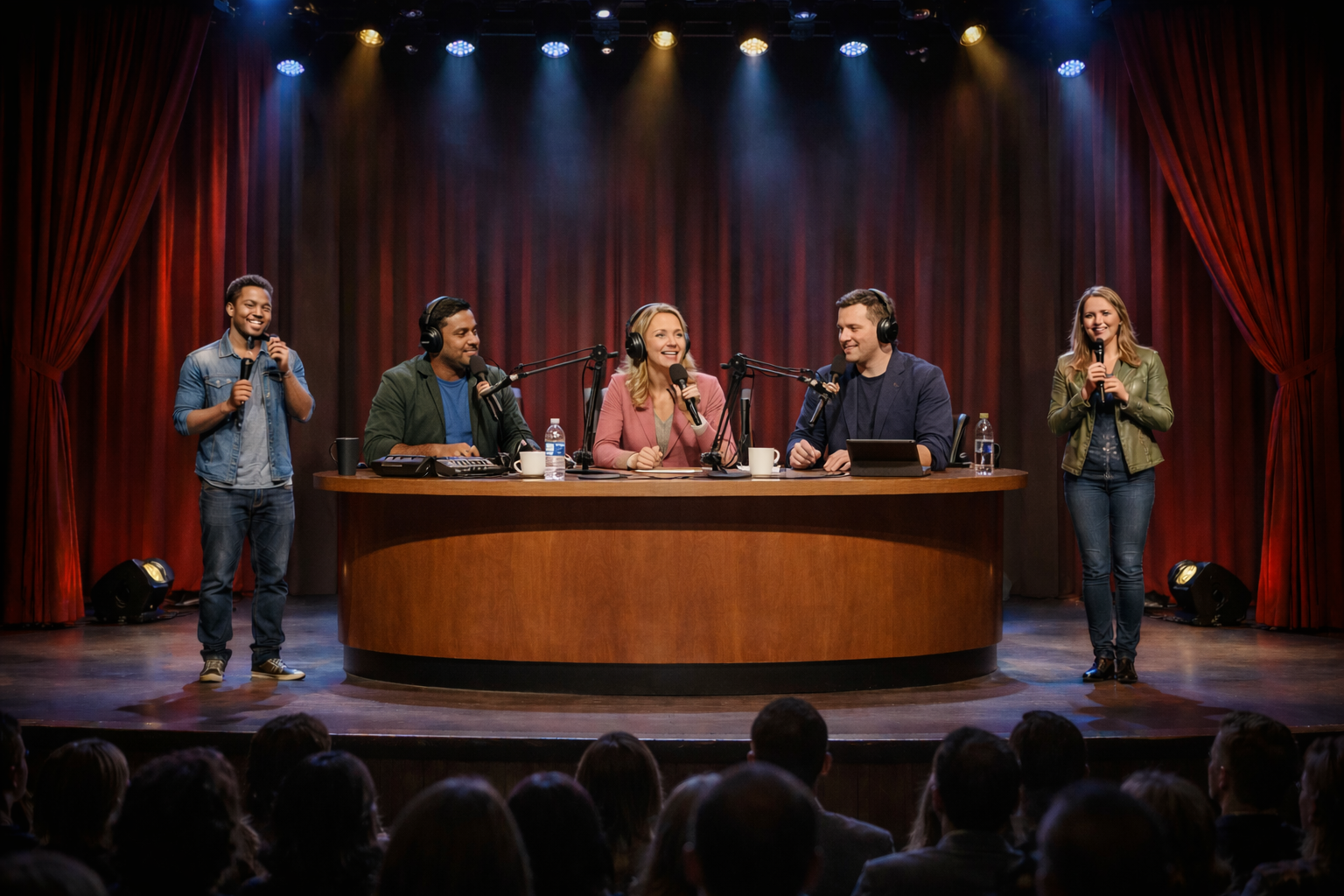
Podcast Summary:
Blind Abilities – The Musical: O&M and the Scarlet Letter B explores the deeply personal moment when a white cane shifts from symbol to tool, from stigma to freedom. Through music, storytelling, and candid conversation, the episode traces the emotional arc of orientation and mobility—hesitation, acceptance, learning, and momentum. The songs frame lived experiences many blind and visually impaired people know well: the fear of being seen, the relief of being understood, and the confidence that comes from trusting your skills. “The cane chose me” becomes more than a lyric—it’s a turning point where independence replaces resistance. The discussion that follows grounds the music in real-world experiences, from early reluctance and public missteps to training breakthroughs and hard-earned pride. Together, the musical and conversation celebrate movement, adaptability, and self-direction, reminding listeners that independence isn’t about perfection—it’s about learning to read the world differently and continuing forward, one step at a time.
Full Transcript
Jeff: Welcome to Blind abilities. I’m Jeff Thompson. Blind abilities. The musical started out as a simple concept, an idea we wanted to experiment with. Our first release got some amazing feedback and a lot of thoughtful responses from you, our listeners, that encourage us to head back into the studio and put together episode two of the musical. And from that feedback, we decided to change things up. We now put the musical front and center, with the discussion following on the back end, and by the time we rolled into the upcoming episode three of the musical, well, we’re starting to think that we got this whole musical thing figured out. So thank you for your feedback and being part of this journey with us. If you’d like to reach out, you can leave us a message at (612) 367-6093. That’s (612) 367-6093. We’d love to hear from you. And now, without further ado, here’s blind Abilities, the musical O&M and The Scarlet Letter B. Be sure to stick around for the discussion following the musical. We hope you enjoy!
{Music}
Singer: Step into the story here. A brand new view. Life keeps changing, but the way we move does too. From the tech we’re wearing. To the roads we roam. Finding our direction. Calling this world home. Blind Abilities – The Musical. Every voice rising. Standing tall. Different ways of seeing. Strong and real and true. It’s not what’s missing. It’s what we do. From Braille in our fingers to the cane in our hand. We’re learning. Living. Making our stand Blind Abilities – The Musical. Come take the ride. Come hear it all.
Jeff: Good evening. Welcome to Blind Abilities the musical. This episode takes us into a moment that many people don’t talk about out loud.
Lori: It’s the moment when independence feels heavy, visible, and deeply personal.
Pete: When a simple tool becomes a symbol not just of movement, but of identity.
Sree: And when the world starts to recognize you in a new way.
Pete: Before you’re fully ready to recognize yourself.
Jeff: The first act of the musical is about hesitation.
Lori: About stigma.
Pete: About that internal conversation we all have.
Sree: Because sometimes the journey doesn’t start when you decide.
Jeff: Sometimes…
Lori: The cane picks you.
{Music}
Singer: I stood at the doorway, keys in my hand, hard doing circles. I didn’t plan. They said, here it is, just plastic and white. But it felt like a spotlight under street light. I knew what it meant. Yeah, I knew the stairs, a symbol, a signal, a public affair, a scarlet letter, capital B.
Singer: Before I spoke, the world knew me. I tried pockets, walls and memory maps. Counting my steps fell into gaps. But freedom kept knocking. Wouldn’t let it be. Then the cane leaned over and whispered to me. I didn’t choose it. Truth be told. Like a wand in a story I used to know. I fought it, feared it. Tried to disagree. But the cane. Yeah, the cane chose me. Now curb cuts talk and stairs make sense. Sidewalks run with confidence. I walk my line. I finally see the cane didn’t mark me. It set me free. They think it’s weakness. Think it’s a sign that I don’t belong on this side of the line. But I’m crossing streets, catching The strain. Reading the city through taps and grains every click says you’re doing fine. Every sweep draws a boundary line. Not asking permission, not waiting around. I navigate life by sound and ground. Yeah, eyes can miss what courage sees. And dependence has its own kind of keys. If anything, it means staying still. I’ll stand up. Walk on. Always. Well, I didn’t choose it. I chose to be a traveler, a mover, independently. Call it a label if you need to see. But the cane didn’t brand me, carried me. So here I am, upright, free. Walking my world unapologetically. The journey began the day I agreed the King didn’t find me. The king chose me.
Jeff: That moment changes the air around you.
Lori: What once felt like exposure starts to feel like awareness.
Pete: The cane stops being something you carry and becomes something you trust.
Sree: It teaches rhythm. Feedback, confidence. One step at a time.
Jeff: But the cane alone isn’t the journey.
Lori: It’s what you learn to do with it.
Pete: How you move with intention.
Sree: How you began to read the world differently.
Jeff: The next act takes us into that learning space.
Singer: Up to your nose. Yeah, that’s the guide. Not too short, not way outside straight or folding telescopic to. Pick what fits the day for you. Telescopic slick buffet warning sign. If it slides mid-step, that’s a whoops type time. Metal sings Nylon’s light mushroom glides just right. Borrows smooth disk, stays wide every tips. Got a job outside sound and feel straight or plain. You get to choose your cane. Urban streets of trails and sand. All terrains got you back in hand. Hiking pass a beach day. Fun, different tools when the ground gets rough. In a diner. Long canes, tricky space folded up. Yeah, that’s the place. Watch car doors. They bite real fast. Snap goes a cane. Lesson learned at last. Airport line. Let it scan or take an elbow. That’s the plan at home. A hotel parking near the door. So adventures ready when you’re out once more.
Jeff: Why now? Something has shifted.
Lori: Fear gives way to curiosity.
Pete: Uncertainty turns into problem solving.
Sree: And independence starts to feel less like a destination and more like a process.
Jeff: Orientation and mobility isn’t about learning every route.
Lori: It’s about learning how to adapt.
Pete: How to recover.
Sree: How to keep moving forward.
Jeff: This final act is about momentum.
Lori: About growth.
Pete: About learning to trust yourself.
Sree: This is learning the way.
{Music}
Singer: La de da doo doo doo da. I didn’t wake up knowing how to move. Didn’t learn this all in one afternoon. There’s a training. Walking just a step away. Saying ask the question. Don’t be afraid. Practice when it helps. Pause when it should. Some days you try. Some days you look good. Taking an elbow. That’s not a crime. It’s just another tool at the right time. This ain’t boot camp. This is real life. Ground to sidewalk. Furniture’s all around this line. Let the cane explain. Every tap is information gain. So I learned the route. I learned the feel. What’s ahead, what’s curb. What’s real. Not rushing fast, just movin free I’m learning the way the world talks to me.
Jeff: That’s what the journey sounds like.
Lori: Not perfect, not polished but practiced.
Pete: Built on confidence, repetition and resilience.
Sree: And shaped by every step taken independently.
Jeff: Tonight we explored what it means to move forward.
Lori: To be seen.
Pete: To be skilled.
Sree: And to be self-directed.
Jeff: This has been blind abilities. The musical.
Lori: Where lived experience meets rhythm.
Pete: And independence, finds its voice.
Sree: And be self-directed. Thank you for listening.
Jeff: Good night.
Singer: Blind Abilities. The musical Every Voice rises. Standing tall. Different ways of seeing. Strong and real and true. It’s not what’s missing. It’s what we do. From Braille in our fingers to the cane in our hand. We’re learning. Living. Making our stand. Blind. Abilities. The Musical. Come take the ride. Come hear it all.
Jeff: The cane picked me. This topic is basically about that stigma that you haven’t used the cane. Your eyes are getting to the point where you should use it, but you don’t do it. And then finally, there comes a point where I better use it.
Lori: Yeah, I think a lot of it is to identify that you’re blind for everyone else to know that.
Pete: That’s right.
Lori: But also to get you using it for your own safety.
Pete: I remember when I first started to use the cane. I was very reluctant even then, and I always wanted to use a little tiny one. You know the identity cane. It was like 2.5ft long, and, you know, you could fit it up your sleeve if you needed to. But I was always embarrassed, so I figured I would use that when it was less conspicuous.
Lori: Well, for me, I didn’t feel like I was worthy of using a cane because I had sight. So I ended up going to a convention, my first convention, and one of the people there said, hey, here’s a cane, use this. I felt like I was lying because I still had a lot of vision, but I didn’t have enough vision. I had enough to get myself into trouble and not enough to get out.
Pete: Yeah, right.
Lori: They gave me the cane and I felt accepted. And that’s when I got into a group of people that I was, like, almost feeling at home.
Pete: Exactly.
Sree: I know for me, taking the cane out the first day was telling myself, I’m a blind individual and I’m okay taking it out. But I will give you a funny story that told me why it’s important to take the cane. So I was walking in a store in a mall, and my wife led me to just go look around. So I’m, you know, at that point it’s just feeling touch, finding things on a table. And I had all these shirts and t shirts that were folded. So I’m just kind of following the trail of the table. And then I’m touching what I thought was a mannequin. And I’m kind of feeling the side of this. And all of a sudden I realized it was a lady standing there.
Pete: Oops.
Sree: Next thing is, you know, she jumped and her boyfriend came running over to me, like, what are you doing? And I had to say, you know, I’m really sorry, but I’m blind. And as soon as I said that, they were both perfectly fine and they were okay. But obviously, if I had my cane with me at that moment, she would have probably moved out of the way, or she would have known that, hey, there’s a person who’s visually impaired walking around. But that taught me a lesson about not only protecting myself, but protecting others by letting them know that here’s a blind person walking around.
Jeff: And that’s part of the identity thing, that you’re identified. The public knows you before you even know it, because you got the scarlet letter B, you know the cane with you, you’re blind. And then they understand. But like Lori was saying, it is an identity thing because I used to walk into a store and ask where something was and they say it’s an aisle three. Well, that didn’t help me too much, but if I walked in with the cane, they would say, oh, just a second, and they’d come around the corner and go down to aisle three and they say, oh, it’s over here. Do you want red or blue? Something of that nature? Or if you’re standing at a bus stop and the bus pulls up and he asks the bus driver, what number is this? He says, it’s on the front of the bus. And I said, well, I’m busy impaired. He says, how would I know?
Pete: Aha!
Jeff: And it dawned on me. So I started using the cane for everybody else’s reasons, I thought, but pretty soon it’s pretty evident that it helps me too.
Sree: And also, when I took the cane out, my chin was up like I wasn’t looking down. I didn’t feel afraid or nervous or down. I actually felt pride. You know, if I didn’t have my cane, I’d probably have my head down because I’m so concentrated walking next to my wife or my friend who are guiding me versus having the cane, I’m in control.
Lori: I had a very similar episode in my life that happened to I was at a like a festival, but it was like a crafty type thing. So I was going around and one part of the festival was a lot of Native American stuff, and I was walking around looking at the tables, and I came across this fringe and I was feeling it. And then I just kind of looked up and my eyes met a woman’s eyes. It was, you know, she was in the full, fringy outfit that a Native American would wear, you know, and I’m like, oh, crap. So yeah, it was a realization for me too. It’s like, yeah, again, I didn’t have my cane. There was no identification that I was visually impaired. And after that it was like, okay, it’s time to make a change. That’s embarrassing for me.
Pete: And Laura. You mentioned earlier when you went to a convention and you kind of felt like you were among friends and you felt more comfortable. I noticed that too. Jeff and I actually went to an NFB national convention in Orlando, and I was still relatively new at Cane Travel, and I was obviously uncoordinated. I had very little skills, and that Jeff actually took me aside into the elevator lobby. Jeffrey, I don’t know if you remember that, but you showed me how some of the techniques of using the cane. You took me into a corner of an elevator lobby where there were marble walls and marble floors, a very echoey place. And you told me, well, listen to the cane and listen to it in the corner. And you rattled my cane in the corner, and I started picking up audible cues from the echo. So I got I got an idea on what the shape of the room was and what the direction was that I needed to be heading. So it just goes to show that I think once you’re in an environment like a community environment where where there’s other blind people, you’re a lot more comfortable. And I think then you adopt some of that pride that you’re talking about. And confidence.
Lori: Yeah. It’s amazing at just standing and listening what you can pick up on to help you travel, whether you’re inside or outside, walking by a building on a sidewalk, you can fill that building. You don’t have to touch it, but you feel it. I can feel when I pass by a alleyway between two buildings, or if I pass a tree, you can feel those things just by being in tune with your environment.
Jeff: May the force be with you.
Lori: Absolutely.
Sree: Yeah, I’m actually doing my O&M training now. I’ve been doing it for the past, I would say the last nine, ten months. And I realized, you know, this is really independence. Like, for me, I’m mostly traveling with my family, never really gone solo by myself from point A to point B, and I’m realizing as I do this O&M training that like many of you guys, you know, I’m building the confidence to be able to go from start to finish just by myself.
Jeff: I think one of the big things, it’s the experience that you get from it, because when Lori was saying she felt this, you know, sometimes when you come between an alley or something like that downtown, there’s a current of air, either it leaving or coming at you, and you start to recognize those different voids of space. If there’s brick next to you, it ricochets back. If there’s not, it’s an opening like a lobby would have. And then if there’s carpet, the tactile textures, everything like that starts to make sense. And I remember Pete was at the convention in Orlando, and at some times when events would get out, you would hear like a hundred canes tapping and it’d be like, oh my gosh, but you’d follow the mob in a sense. You would go with the flow if you were going there, like cues that you probably didn’t recognize before. When you’re sighted, there’s a whole bunch of information there that you receive. And once you get the cane, like you said, you’re in that corner earlier, you start to pick up that type of information. And Sri you were saying when you’re with the family it’s, you know, grab an elbow and there’s efficiency, time, concerns and a group going into a restaurant. It’s easy, it’s convenient. But when you’re on your own, like going from point A to point B, it’s exploration, man. You’re just out there exploring, picking up the cues. If you never ran into that bench along the sidewalk that you travel every day, it’ll be a new discovery someday. And then the second time you hit it, you’ll go, ah, the bench.
Pete: Yeah. And the second time you’ll hit it with your cane instead of your shin. Yeah.
Jeff: And the person sitting there will say hi and you go, oh, excuse me.
Lori: When I went through ATB, I chose a center where I wanted to wear sleepshades because I knew I had RP and I knew the day would come where I wouldn’t be able to see anything. And I was a single mom with two kids, and I wanted to be a role model for them and show them that we can do this as a team, you know? But I needed to get the training. I needed to do that. And I remember at the center, you have certain things to get through the program. And they were drop offs. And I remember my first drop off and put you in the car and you’ve got your sleepshades on, and they’re driving around and around and around and around just trying to really confuse you so that when they drop you off, I have no idea where I’m at. And I just remember my O&M trainer when I got out of the car. My last name was Brown then, and I had two kids and he said, and I was scared to death. And he goes, do it for the brownies. And that just really I’m like, okay.
Lori: Head went up, cane went out, and they drove away. And I just sat there and listened and listened and listened. And often the distance I could hear like a bus and I’m like, oh, that’s a good cue. So you start walking and you try to get to that location, and then you smell a coffee shop or something, you know what I mean? And you can hear the traffic stop, like at a stop sign or something. So, you know, you’re at a corner and you couldn’t ask questions. But I finally found the bus stop and I heard the number four. And I’m like, okay, I know that the number four runs on such and such street. So it’s like, now I just got to know whether I need to go north or south, you know what I mean? And luckily in Minneapolis, they’re really good about calling out the streets. So I just hopped on the bus and just started listening and found out which direction I was going. You know, eventually I made it back to the center. It was amazing for me.
Pete: Great story. I remember when I went to O&M training, I went to a state office building in downtown Jacksonville, and the first 2 or 3 appointments that I had, my wife dropped me off and I thought to myself, well, I’m not learning anything by getting out of the car at the curb and walking 30ft and finding the front door. So I from then on started taking the city bus here in Jacksonville and going through the whole routine. You know, she would at least drop me off at the bus stop. But from there I would get on and off the bus and I would find my way a couple of blocks from the bus stop to the city building, and I would go into the building and hook up with the O&M instructor and experience the entire lesson on my own, which really, really helped me immensely. Sometimes that’s the best way, like getting a drop off. Sometimes that’s the best way. There’s no better way to learn how to use your cane than to have to learn how to use your cane.
Lori: Well, and also to have that confidence, because that O&M instructor, I had trained with him for a couple months, and he had the confidence in me to know that I could do it. So that just validated that I should have the confidence in myself.
Sree: When I first started using the cane and I first got the cane, I was, you know, I’m kind of the person that I don’t like to touch walls, I don’t like to bang on things. And I’m swiping my cane and I’m like tapping the walls really soft because I don’t want to offend people around me or the building or all this other stuff. And my instructor says, just whack it. You know, just whack it. So now when I’m going to the mall, I’m just whacking it.
Pete: That’s what the cane is for. You’re supposed to find obstacles. That’s how you get your feedback.
Sree: For me, like I said, maybe I don’t know if it was germaphobic or whatever it is. I was just. I didn’t want to touch anything. You know, because I never used to. I just looked and moved around, and now it’s like I touch everything. You know, it doesn’t even bother me that whatever I’m touching, because I know that’s that’s part of for me to learn to get around is using the cane and feel things around you with it.
Jeff: When I was in training, I think one of the rewards was you got to go down and get a coffee. You know, it sounds stupid. It’s like, okay, you’re not going to do any training, you’re just going to get a coffee. But that’s a special thing to be able to leave a building in downtown Minneapolis, go down three blocks over two, three blocks, cross the street three times, four times, and then a light, a lighted street corner. You have to cross to get to the coffee shop. So it sounds easy and then you have to pay for it. And, you know, our training was under sleepshades, so you had to pay for it back in the day where everyone didn’t use a credit card, you know. Right. So you had to pull out your money. And so a lot of it in a training adjust ATB what Lori mentioned earlier is adjustment to blindness training. There’s centers. But if you just get O&M training by one person, they’ll bring you around to different places and you’ll have to go through those motions of stuff that you’ll build upon that you can transfer those skills to other places, other cities. The cane doesn’t know directions. No, it’s not like a guide dog, and a guide dog doesn’t know directions. You still have to be aware of what streets next. That’s why a lot of these GPS apps were popular back in the day, because you could drop breadcrumbs here and there, right? And it was great for travel in that sense.
Jeff: But when you’re living in an area and you’re staying in that area and you frequent a few places, after a while, it’s like the back of your hand in a sense, like we were talking. You start recognizing smells, sounds, feel the ground, everything. When we were talking about canes. Oh, there’s so many types of canes. And it used to be there’s only one type of cane. And we were talking earlier about training centers and kind of like boot camps. A boot camp, I would say, would be like an NFB center training where you’re in a group of people and you’re all training. It’s like a boot camp, in a sense. And there’s certain rules, regulations like don’t ask questions. Well, it’s not like the real world. They’re just trying to make you think, you know. So think for yourselves, like figure it out. If you ask questions for everything, you’ll never figure it out on your own if there’s very few people around. So that’s what that is like. But when they first gave me a cane, it was a long cane and I used it. Then I got to try different types of canes and then a telescopic cane and a folding cane, and then you start realizing, well, in this situation this would be better. So after a while you start having three four canes. And they’re for different purposes.
Lori: Yeah, and sometimes they’re heavier than others. Sometimes they’re lighter than others. There’s carbon fiber, there’s graphite, there’s aluminum. There’s a cane that will fold up into four sections. There’s canes that will fold up into seven sections. They have the metal tips. They have the marshmallow ball tips. They have the rollerball tips. It’s just a preference. Once you get into your training, you’ll figure out what works better for you. We’re not all cut from the same cloth. We’re all still individuals and everybody has their own.
Pete: You know, as you were listing all of those different styles and foldable sections and all of that thinking in my mind, I think I’ve got one of every one of those that you mentioned. I’ve got one that folds up into four sections so the sections are longer. It’s harder to store in my briefcase or in my pocket. I’ve got a telescopic cane, but they’re so limited because they tend to collapse. I’ve got a straight cane, but sometimes they’re not practical. Depending on where you’re going. It’s almost like I’ve got a different cane for different types of travel, different needs.
Jeff: Three. Have you ever used a telescopic cane?
Sree: No. I was just going to tell you guys that I have one static cane, and that’s all I’ve been using since I started. The only other cane I have is the all terrain cane, which I barely ever used. But it’s it’s there. It’s. And those are the only two styles that I have.
Lori: What kind of cane do you primarily go to?
Sree: I have the cane, and I actually like it because it’s it’s light. It’s also very sturdy because I tend to lean and it seems to hold my weight.
Pete: Okay.
Sree: It is a foldable cane. Yeah.
Jeff: The telescopic cane is convenient. It’s nice. It’s stylish. I call it like when you’re going to dress to the nines. Yeah, it fits the attire really well. But the thing is, if you’re ever walking along and itself collapses a little bit, like one of the sections slides into the other one, it feels like you’re falling right down a hole.
Pete: Exactly.
Jeff: And that sensation kind of like when you go down steps and you think you’re one step away from the bottom, but you’re already at the bottom.
Pete: Not really secure.
Jeff: No. And then the cane tips that Laurie was mentioning, you know, some give good sound, like the metal tips. They tap, tap, tap. They give you so much information back. And then there’s nylon ones that are more, um, I guess, uh, delicate rolling ones, round ones, spinning ones, mushroom tips and ball rollers that always make constant contact. There’s something for everyone, but during training, they usually try and give you something that will get you to tap and to make your sweeps. So from your left shoulder to your right shoulder. So if you’re right handed, you want to swing it a little more to your left than to your right. And some people want to hold it in the center, but people don’t like to do that because they get jabbed. There’s an anti-jab cane so it doesn’t. It has a spring collapsible right. Yeah I’ve seen those. So during the training you get to learn what to do, how to use it and all that. But after training, you’re going to start to like if you go to a convention, you’ll see ten different styles of canes and tips and all that. So like Lori said, you know, you get to choose.
Pete: And different lengths. Jeffrey, some people believe the standard length should be right to the bottom of your nose, right to between your upper lip and your nose, and that gives you a certain degree of security when you sweep or when you tap, obviously you’re going to be notified of an obstacle earlier than if you’re using a shorter cane. But there are others who truly believe that a cane should only be, as long as it comes up to about the center of your chest, and that you then extend your arm to use it. So there’s different styles of using the cane and different lengths that will suit you. And it will all depend on who’s teaching you and what they expect that you’ll learn best.
Sree: For me, when I went to India, my Ambu Tec cane wasn’t very useful because the terrain was just unpredictable. You have potholes galore, uneven roads, uneven ground. I mean, there could be all kinds of obstacles. You know, we complain about obstacles on the roads here until you travel in the small town in India. You really understand what obstacles really mean. I was not very successful using the cane because you can’t swipe, you know, like the normal swipes that we could do as we’re walking around here. It just was manageable, you know? I actually had to have somebody help me or start giving me guidance because I just couldn’t figure it out. It was just very, very difficult.
Jeff: One of the canes made by a werewolf gear is the all-terrain cane. You mentioned you had one, Sri, I have one. And when I go on like a canoe trip where we’re going to go some hiking or stuff, it’s great because then you can really lean on that. It’s stronger than the strongest cane I’ve ever seen. And it’s a folding cane and it has a ball on it. But when you’re going on hiking trails and stuff, a typical cane is not useless. It’s good, but that’s all it’s good for is finding. But with, uh, the all-terrain cane, you can actually use it to lift yourself up a little bit, brace yourself and smack it around a little bit. They also make the Urban Explorer, which is a little less than the All-Terrain Kane in size, but it’s a little more stronger. So if you’re in an area where you bang and clang a lot and you’re proud of it, well, this thing would probably last you a little better. And both of them have a lock on the handle where you can extend the handle 6 to 8in, I believe something like that. So it’s versatile in size for different situations. So it’s interesting to just explore, see what you like. And after a while you might have a few, but you’ll have a purpose for each one of them.
Pete: And with those two, the Urban Explorer and the All-Terrain Kane, you can use them almost like a support Kane. It really helps stabilize your balance. You can lean on them. And again, they’re made for off road terrain. You know, if you’re climbing up a hill or a slope or going down into a gully where you need a little bit more support to lean on to keep your balance. So those are good to know too, and that might help when you’re getting on and off a bus, or on and off a train or climbing stairs or something like that. So yeah, you can have a cane for each of your purposes.
Sree: I think when I was in India, I was actually thinking about that. I said, I brought the wrong cane, I should have brought the other cane. I should have brought my all terrain cane because I think.
Pete: Sounds like it.
Sree: It would have helped me. But, you know, I’ve used it a little bit and I find my wrist gets really tired after some time, so. But I should have taken that one with me when I went.
Lori: Next time, next time.
Sree: Lessons learned right?
Lori: Lessons learned. That’s all. Life is a journey.
Sree: Yeah.
Lori: I remember one of the times I came up here. I just started knowing Mr. Thompson and I hadn’t moved up here yet. And I came up and he met me at the airport. We were walking along and he said, there’s an escalator. Well, I thought the escalator was going to go up. No escalator was going down, and my cane actually saved my life. And maybe Jeff’s arm too, but my cane just bowed. I took a step and it was cane hit the the step that was going down. I was getting ready to take a step up and my cane. I just leaned over and my cane, like, bowed completely. It looked like a bow and arrow.
Jeff: I remember that, and since I was a teacher, I’ve been around students. I’ve taken them to the Mall of America, coffee shops, ice cream shops, all sorts of. So as we were getting to the escalator, I went on first and then turned, you know, here’s a person with a cane coming behind me. And as soon as something wasn’t right, you could just tell. I reached across and grabbed the opposite rail. So I formed an arm brace and she came right into it. And that was the one that goes down to the train, which is about, I would say it’s a 60 foot drop.
Sree: Wow.
Lori: Yeah. Yeah.
Sree: So Lori did that win some brownie points?
Lori: It did. Oh it did. Yeah. He’s a keeper. All right. But have you ever like, shut your cane in a car door or. I’ve lost a cane down an elevator shaft.
Pete: I have to. Yep. Down in that little slot between the car and the floor. Yeah.
Lori: Yes. It is the most helpless feeling when you lose your cane and you don’t have any way of. It’s like, oh no, what do I do?
Jeff: You got that one back, didn’t you?
Lori: I did, luckily they had a key and they were able to go down and get it. Yes, but.
Pete: Tell me Jeff went down and got it for you.
Lori: No no no no no.
Sree: But I think it’s a very important thing. You know, if you just have one cane, it’s really good if you have some extra ones back up. You know, some people have said, you know, you should always take two canes when you go on travel, you know, just just to be safe.
Lori: Yeah. I was a guide dog user and I always carried a telescopic cane in my backpack, in case, you know, you never know.
Pete: Not around anymore or what?
Lori: Loki has passed.
Pete: Away.
Lori: We put him down in November. Yeah.
Pete: Sorry, Lori.
Lori: Yeah, yeah, but, you know, in case he gets sick or something, you know, it is good to have a backup cane.
Sree: One type of cane. I don’t know, Jeff, if it’s in the agenda, is the smart canes. Are you going to cover those too, or.
Jeff: I think you should just duct tape your phone right to the cane. I mean, if you’re going to spend, what, 35 45, 60 bucks on a cane. It’s great to have all those techniques. I wouldn’t start out by getting a smart cane. I wouldn’t start out by getting a guide dog. I wouldn’t start out by just doing anything other than learning the ropes. Yes, a little bit. Because even if you’re lost somewhere, you could always pick up a stick.
Pete: That’s right, a broomstick. Yeah, yeah.
Jeff: And the best cane you have is the one that’s in your hand. Right. We can talk about types and styles and tips and all that, but if you’re lost and you find a nice stick, you probably know how to use it.
Sree: Well, that’s how it kind of started, right? People just used a stick in the beginning, right?
Lori: Yeah, probably.
Jeff: We’d have to ask Pete. Pete goes way back.
Lori: Hey.
Jeff: Well, no, he’s the longest. He’s the longest cane user we have right now, isn’t he?
Lori: Well, in this.
Jeff: In.
Lori: This, in this group. Yes.
Pete: You just say it. I’m the oldest one.
Jeff: No no no no, it depends on when you went blind. I would say 97, 98 for you? Yeah. I started using a cane.
Pete: I was a little after that.
Lori: Yeah.
Pete: Me too. I should have back about 97 or 98, but I didn’t. Which is a whole different discussion. The reluctance that we have to use a cane for whatever reason, there’s a lot of reasons.
Jeff: And that’s an important part of it, because there’s people that are listening that are at that point where they don’t want to use a cane because like we said, it’s the stigma. Yeah, it’s society looking at you and identifying you instead of just, you know, you’re the Waldo in the group now. Find Waldo. Well, you got a cane.
Pete: That’s right.
Sree: Yeah. For me, it was really interesting because my older brother and sister, they’re also blind. And my sister, for the longest time refused to use the cane. As a matter of fact, she said to me, I ain’t using a cane. And so we had this family get together where I. I was diagnosed with RP at that time. And my parents did not know that I had RP. So I talked to my brother about this, and we all decided it’s probably best to tell my parents and my sister. So we were at my sister’s house in California, and I was telling them, you know, I have RP and here’s my condition and so on. So and I get back to Washington, D.C., and I get a call from the Columbia Lighthouse. It was my sister who called them and said that I need my cane training.
Pete: Wow.
Sree: And I was like, thinking to myself, I go, my sister, who refused to use the cane, wants me to get the cane training. And obviously as time passed, my sister has done her cane training and matter of fact, she travels by herself around the world. So I applaud her for encouraging me to do the cane training because, you know, it is a very important and it’s a tough choice to make because first of all, I had to admit that I was blind and I’m going to probably need some assistance. And the cane is one of those assistants that I need to learn how to use.
Jeff: It’s a neat moment that you recognize in yourself, and once you come to terms with that, it changes everything.
Sree: Oh, it does, it does. I remember I still remember the first day I took the cane out. I just felt so relieved because I had all this tension about not taking the cane out, because I’m going to be a blind person. Everybody else is going to see me as a blind person. But I didn’t feel that when I took the cane out. When I went out, I felt like I’m free.
Pete: I think a lot of people listening are thinking to themselves, well, I’m in that situation, and it might have a lot to do with where you’re coming from. If you have grown up and been in the sighted world, say your entire family is sighted. No one has vision loss. None of your friends have vision loss. Well, all you’re used to and all your friends and family members are used to are sighted world things. And like Jeff said earlier, now you’re the Waldo. You’re the different person. So it’s a very difficult transition to get into the mindset of having to use a cane, because now you’re on display.
Lori: Yes, and I hope that everyone remembers that. It doesn’t make you less of a human. You know, that was the biggest thing for me. I would put myself in a spot where I would make myself feel inferior. I was so afraid to go out in public because, you know, they’re looking at you. They’re waiting for you to not find the door handle or run into the bus stop or whatever it is. You know, you just feel like they’re constantly watching you. But it’s okay to not find the door handle right away. It’s okay to maybe brush up against something. Sometimes you get to the corner and you want to cross. I can tell you right now, I still to this day, don’t cross a street in a straight line. I might veer to the right or left and hopefully it’s not into the traffic. You know what I mean? I mean, I’m not perfect, but it doesn’t make me stop. But I know that I’m the only one that can get me to and from when I need to get to and from. And I’m a human being, and I’m not less of a person because I can’t see.
Sree: Well said, well said.
Pete: You might even be more of a superhuman being because you have this skill that no one else has.
Lori: Absolutely.
Pete: It’s your superpower, Lori.
Lori: Yeah. And you know, when I started training, because I have R.P. and with all the adjustments that I was constantly doing, putting those sleepshades on, man, it just took the white noise away. And I was so focused and so ready. I was ready to be blind. You know what I mean? I was ready to be blind because fighting every month to month, year by year, all these changes and learning how to adapt and making new transitions with it all, it was just so comforting just to put the sleepshades on and just go.
Pete: I’ve never done that.
Jeff: Well, like Cheryl said in the last podcast episode one, she said, you’re always transitioning as you’re losing more and more, but once you’re blind when you wake up, it’s the same as it was yesterday. It’s the same. So then you can build.
Lori: No struggle.
Jeff: Right? Oh, your skills are going to be there for you. Whereas as you first. Yeah. I don’t need that I still got. I don’t need that. I don’t need Braille. I can do this and all that, you know. So yeah, there’s a transition period from starting to lose your sight until you, you know, when you’re unusable. Sight, I guess, is a phrase you might be able to see some stuff, but it surely doesn’t get you to the men’s room.
Sree: Yeah.
Pete: Hey, Jeff. I think the three songs that we’re dealing with in this episode really cover the waterfront in terms of the transitions that we have to make, what to do, how to choose our cane, and then the one that is entitled My Cane chose me. Where did that title come from?
Lori: I told Jeff, I love Harry Potter. Oh that’s right. And I said, I think it should be kind of like how in Harry Potter the wand chooses the wizard or the witch? And I said, that’s what I wanted. Was that line put in there?
Jeff: We sit at the table and talk about it, and I’m compiling all this, and we talked about how all these ingredients are going to go into this song. Right. And that’s where we start from. We just brainstorm. We’re over coffee now, son. It’s 7:00 and she has to go to work. So I sit down and I putz around with it and putz around with it. And pretty soon I’m sending it to Pete. Yep.
Pete: Great job with these songs, by the way. The lyrics are right on.
Sree: Yeah. It was. It’s very appropriate and very touching.
Jeff: I like it because it’s a different style of a podcast that we haven’t seen out there. Whether you like high school, what is it, the musical.
Sree: High school musical?
Jeff: Yeah.
Lori: Wicked, wicked.
Pete: And you can learn by them if you listen to the lyrics.
Lori: Absolutely.
Pete: While you’re being entertained.
Lori: Exactly. Yeah.
{Music}
Singer: Blind Abilities – The Musical. Every voice rises. Standing tall. Different ways that seem strong and real and true. It’s not what’s missing. It’s what we do. From Braille in our fingers to the cane in our hand. We’re learning, living, making our stand Blind Abilities – The Musical. Come take the ride. Come hear it all.